32/34, Jintan Udhyognagar, Behind Gas godown, Surendranagar – 363 002, Gujarat, INDIA.

How to Select a Surface Grinding Machine for Batch Production
Introduction:
Batch production requires consistent quality, predictable cycle times, and efficient use of manufacturing resources. Choosing the right surface grinding machine can help manufacturers maintain dimensional accuracy, achieve the required surface finish, and process multiple components efficiently. However, the best machine depends on factors such as workpiece geometry, batch size, material type, tolerance requirements, and production frequency.
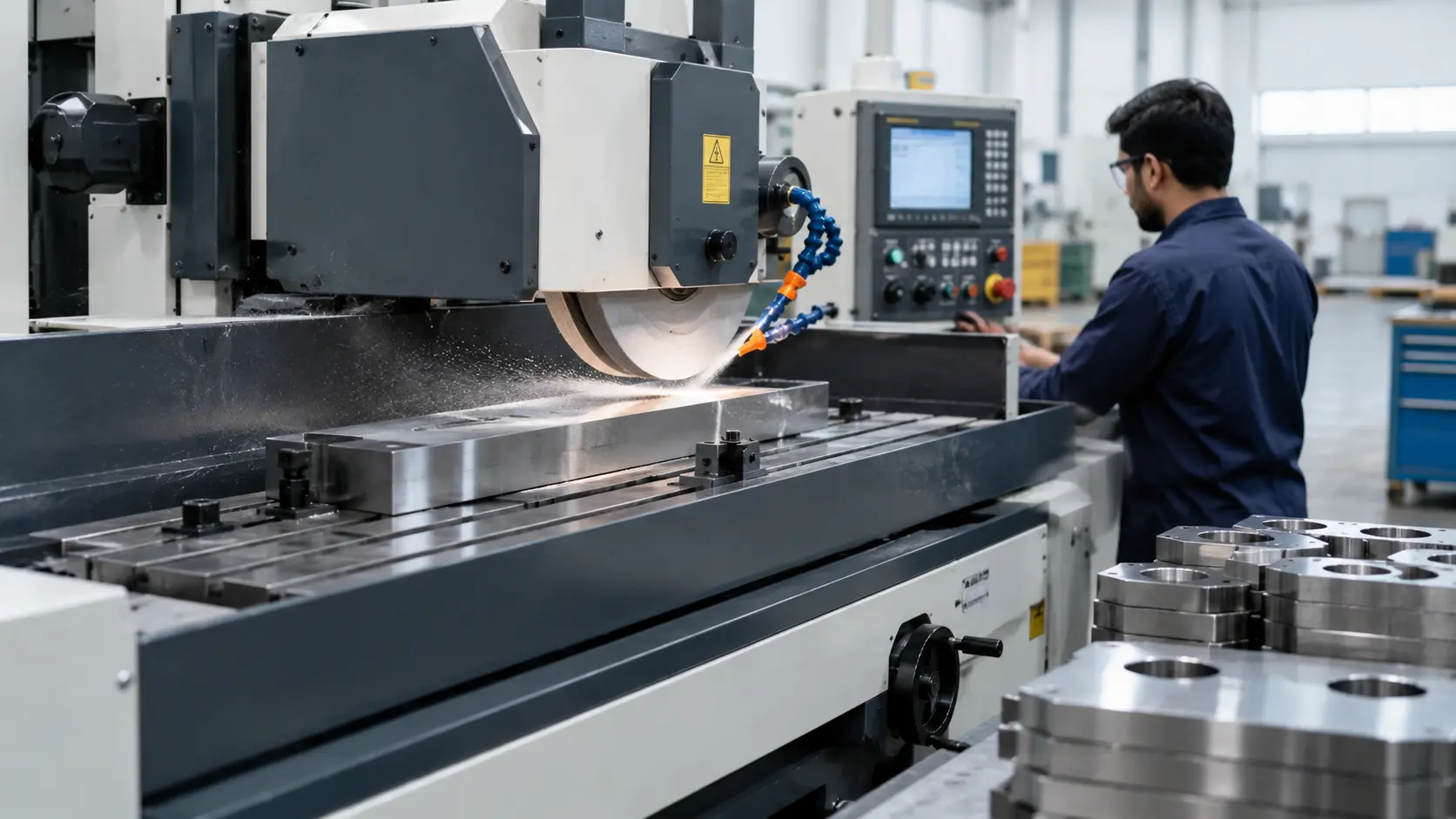
Understanding how to select a surface grinding machine for batch production helps manufacturers match machine capabilities with their actual production needs. Rather than focusing only on the initial purchase price, it is important to evaluate accuracy, automation, grinding capacity, tooling requirements, and long-term operating costs.
Understand Your Batch Production Requirements
Before selecting a machine, define the requirements of your production process. Batch production can involve small quantities of precision components or thousands of identical parts manufactured repeatedly.
Consider the following factors:
- Batch size: Determine how many components need to be ground per batch and how frequently batches are produced.
- Component dimensions: Check the length, width, thickness, and overall geometry of the workpieces.
- Material type: Identify whether components are made from hardened steel, stainless steel, cast iron, or other suitable materials.
- Production frequency: Evaluate whether the machine will operate occasionally, daily, or across multiple shifts.
- Quality requirements: Establish the dimensional tolerances, flatness, parallelism, and surface finish required by the component drawing.
For example, a manufacturer producing precision rectangular plates in repeated batches may benefit from a machine that supports consistent workpiece positioning and repeatable grinding operations.
Choose the Right Type of Surface Grinding Machine
Hydraulic Surface Grinding Machine
Hydraulic surface grinding machines are suitable for applications requiring controlled table movement and consistent grinding operations. They can be considered for general-purpose precision grinding where the production volume and operating requirements align with the machine's capabilities.
Automatic Surface Grinding Machine
Automatic surface grinding machines can reduce manual intervention by automating selected movements or grinding cycles, depending on the machine configuration. They may be useful for repetitive batch production where consistent operating sequences are important.
CNC Surface Grinding Machine
CNC surface grinding machines offer programmable control over supported grinding operations. They can be advantageous when production involves repeatable cycles, complex operating sequences, or multiple component specifications that require controlled setup changes.
The right choice depends on the balance between production volume, component complexity, required accuracy, operator involvement, and budget. Review the actual machine specifications and automation features before making a decision.
Evaluate Grinding Capacity and Workpiece Size
Machine capacity directly affects which components can be processed efficiently. Before purchasing, check the maximum grinding length, width, vertical clearance, and workpiece weight supported by the machine. Also consider the size of the magnetic chuck or other workholding arrangement, as well as the clearance required for loading, unloading, and dressing the grinding wheel.
Selecting a machine with insufficient capacity may restrict future production requirements. However, choosing a significantly oversized machine can increase the initial investment and occupy valuable shop-floor space without providing a practical benefit. The objective is to select a machine that accommodates your current component range while allowing reasonable flexibility for anticipated production changes.
Match Accuracy and Surface Finish Requirements
Precision is a critical consideration when selecting a surface grinding machine for batch production. Components manufactured repeatedly must meet drawing specifications throughout the batch, not just during initial setup.
Evaluate the machine's stated capabilities for:
- Dimensional accuracy and repeatability
- Flatness and parallelism
- Surface finish requirements
- Table movement and spindle stability
- Thermal stability during extended operation
Remember that final results depend on more than the machine alone. Grinding wheel selection, dressing practices, workholding, material properties, coolant application, machine condition, and operator procedures can all affect the finished component.
Ask the manufacturer for relevant technical specifications and, where practical, arrange a trial using representative workpieces to confirm suitability for your application.
Consider Automation and Cycle Time
In batch manufacturing, small differences in cycle time can affect overall production capacity. Evaluate the complete grinding cycle, including loading, positioning, grinding, wheel dressing, inspection, and unloading. Automation may help reduce repetitive manual tasks and improve process consistency, depending on the machine's configuration. However, not every batch production environment requires a fully automated CNC system.
For example, a workshop producing several batches of similar components may benefit from an automatic grinding cycle, while a facility handling frequent product changes may need programmable controls and flexible setup options.Compare cycle times using realistic production conditions rather than relying only on theoretical grinding speeds. Include changeover time and inspection requirements when estimating output.
Check Workholding, Grinding Wheels, and Coolant Systems
Supporting equipment is essential for reliable grinding operations. A suitable magnetic chuck or other workholding solution helps secure the component during machining. The correct arrangement depends on the workpiece material, geometry, and machining requirements.
Grinding wheel selection should also match the material being processed and the required surface finish. Wheel specifications, dressing methods, and replacement frequency can influence both productivity and operating costs. For applications involving heat-sensitive materials or demanding finish requirements, evaluate the coolant delivery and filtration arrangements. Effective coolant management can support temperature control, wheel performance, and surface quality.
Consider these requirements during machine selection rather than treating them as separate decisions after installation.
Calculate the Total Cost of Ownership
The purchase price is only one part of the cost of a surface grinding machine. A machine that appears economical initially may require additional investment in tooling, setup, maintenance, or operator time.
Review the following expenses:
- Initial machine and installation costs
- Grinding wheels, dressers, and workholding accessories
- Electricity and coolant consumption
- Preventive maintenance and spare parts
- Operator training and setup time
- Inspection, rework, and potential production downtime
Estimate the cost per acceptable component where reliable production data is available. This provides a more useful comparison than purchase price alone.
Also check the availability of technical support, spare parts, service assistance, and operator training. Reliable support can be particularly important when the grinding machine is part of a time-sensitive production process.
Assess Maintenance and Future Production Needs
Batch production equipment should support consistent operation over time. Before finalizing your choice, understand the recommended maintenance schedule, lubrication requirements, grinding wheel dressing procedures, and inspection needs.
Ask about service accessibility, replacement parts, technical documentation, and support for troubleshooting. It is also worth considering whether your product range or batch sizes may change in the future. A machine with suitable capacity, flexible controls, and compatible accessories may offer greater operational flexibility as production requirements evolve.
Avoid paying for features that your process does not need, but do not overlook capabilities that are essential for maintaining quality and production continuity.
Conclusion
Selecting the right surface grinding machine for batch production requires a careful assessment of component specifications, batch volume, machine capacity, accuracy, automation, workholding, and operating costs. The ideal solution is one that meets your quality requirements while supporting efficient, repeatable production. By comparing machine types and evaluating their capabilities against real manufacturing conditions, you can make a more informed investment decision.
Pinnacle offers surface grinding machine solutions for precision grinding applications. Explore the range at Pinnacle Grinder and evaluate the machine specifications that best align with your batch production requirements.
Frequently Asked Questions
1. Which surface grinding machine is best for batch production?
The best machine depends on batch size, component geometry, accuracy requirements, cycle time, and automation needs. Automatic or CNC machines may suit repetitive production, depending on the application.
2. Is a CNC surface grinding machine necessary for batch production?
Not always. CNC machines can benefit programmable and repeatable operations, while hydraulic or automatic machines may suit less complex production requirements.
3. What specifications should I check before buying a surface grinding machine?
Review grinding capacity, workpiece dimensions, accuracy, repeatability, spindle specifications, table movement, workholding options, automation features, and service support.
4. How does automation improve batch grinding?
Depending on the machine configuration, automation can reduce manual intervention, standardize grinding cycles, and improve production consistency. Actual productivity depends on the complete manufacturing process.
5. How can I reduce the cost per component in surface grinding?
Optimize cycle time, workholding, grinding wheel selection, dressing practices, maintenance, and inspection procedures. Evaluate total operating costs alongside the initial machine price.
