32/34, Jintan Udhyognagar, Behind Gas godown, Surendranagar – 363 002, Gujarat, INDIA.

Horizontal vs Vertical Rotary
Surface Grinding Machines:
Key Differences
Introduction:
Choosing the right surface grinding machine matters when you need consistent surface finish, dimensional accuracy, and dependable production output. When comparing horizontal vs vertical rotary surface grinding machines, the main difference lies in the grinding spindle orientation and in how the grinding wheel contacts the workpiece.
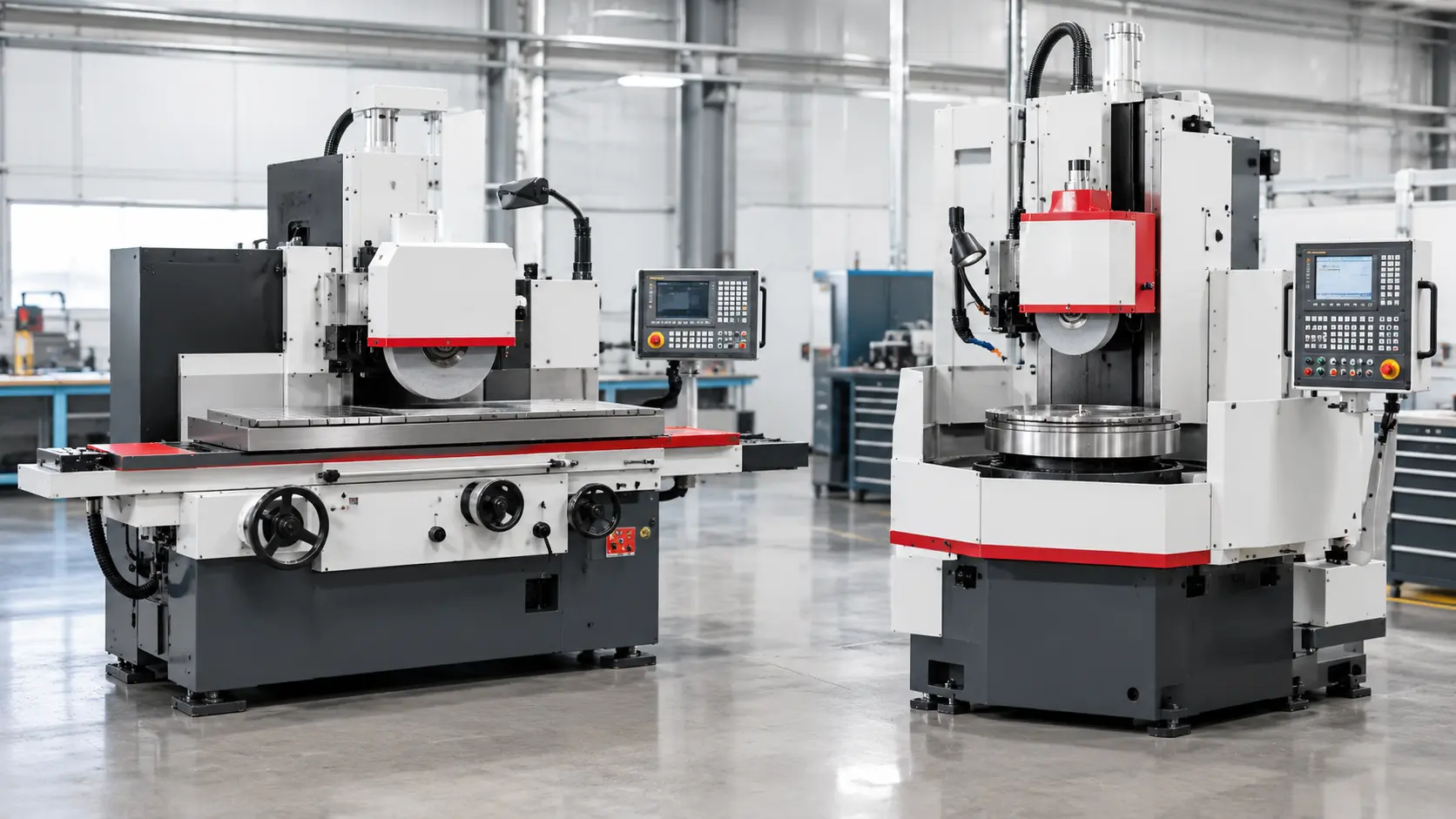
Both configurations use a rotating table to hold components and carry them beneath the grinding wheel. Even so, their grinding methods, material removal characteristics, and suitability for different jobs can vary quite a bit.
At Pinnacle Engineering Enterprise, we know that selecting a grinding machine involves more than comparing specifications. Manufacturers also have to weigh component geometry, material requirements, production volume, surface finish, and the accuracy expected from the finished part.
What Is a Horizontal Rotary Surface Grinding Machine?
A horizontal rotary surface grinding machine uses a horizontally oriented grinding spindle. The grinding wheel rotates with its axis parallel to the worktable, allowing the wheel's peripheral surface to grind the workpiece.
The component is secured on a rotary table, often using an electromagnetic chuck for suitable ferromagnetic workpieces. As the table rotates, the component moves beneath the grinding wheel. Controlled cross-feed and vertical in-feed movements allow material to be removed progressively. This arrangement is particularly useful when manufacturers require controlled grinding across flat surfaces, bearing components, precision rings, and other parts that need consistent dimensional accuracy.
Key characteristics of horizontal rotary surface grinders
- Peripheral grinding: The outer circumference of the grinding wheel does the cutting.
- Controlled material removal: Suitable wheel engagement and feed settings support accurate finishing.
- Rotary table operation: Continuous table rotation helps keep the grinding cycle consistent for compatible components.
- Precision-focused applications: A good fit for components that need controlled flatness, thickness, and surface finish.
- Production flexibility: Depending on the machine configuration, it can support batch production and automated grinding cycles.
What Is a Vertical Rotary Surface Grinding Machine?
A vertical rotary surface grinding machine has a vertically oriented grinding spindle. In this configuration, the grinding wheel faces downward toward the workpiece, and grinding generally takes place using the wheel's face.
The workpiece is held on a rotary table that moves it beneath the grinding wheel. Because the wheel face can engage a comparatively broad area, this arrangement can be effective for applications that require productive grinding across suitable flat surfaces. The actual contact area depends on the wheel dimensions, component geometry, machine setup, and grinding parameters. Therefore, a vertical spindle does not automatically guarantee higher productivity or better results for every application.
Key characteristics of vertical rotary surface grinders
- Face grinding: The working face of the grinding wheel carries out the primary grinding operation.
- Broad-area contact: Suitable setups can engage a larger portion of a flat workpiece surface.
- Production-oriented operation: Can be advantageous for repetitive jobs where substantial surface coverage is required.
- Rotary table movement: Components pass beneath the wheel as the table rotates.
- Application-specific performance: Wheel selection, workpiece material, machine rigidity, and process settings determine the results you can achieve.
Horizontal vs Vertical Rotary Surface Grinding Machines: Key Differences
Although both machine types use rotary tables, the orientation of the spindle changes the grinding contact, process behaviour, and suitability for particular components.
| COMPARISON FACTOR | HORIZONTAL ROTARY SURFACE GRINDER | VERTICAL ROTARY SURFACE GRINDER |
| Spindle Orientation | Horizontal | Vertical |
| Primary Grinding Contact | Peripheral surface of the wheel | Face of the wheel |
| Typical Grinding Approach | Controlled peripheral grinding | Face grinding over suitable surface areas |
| Component Suitability | Flat components, rings, and precision surfaces suited to peripheral grinding | Plates, rings, and flat components suited to face grinding |
| Material Removal | Depends on wheel engagement, feed, and grinding conditions | Can be productive when the wheel face engages a broad area |
| Surface Finish | Depends on wheel specification, dressing, and process parameters | Depends on wheel specification, dressing, contact conditions, and process parameters |
| Production Suitability | Batch and repetitive precision grinding | Repetitive production and applications requiring suitable face-grinding coverage |
| Machine Selection Priority | Peripheral contact, dimensional control, and component geometry | Face contact, surface coverage, and material removal requirements |
These are general differences rather than absolute performance rules. The best machine depends on the component, required tolerances, grinding wheel, and production process.
Difference in Grinding Wheel Contact
In horizontal-spindle machines, the wheel’s periphery grinds the workpiece, allowing controlled material removal. In vertical-spindle machines, the wheel face contacts the surface, making it suitable for grinding broader areas.
The choice depends on workpiece geometry, material removal needs, wheel selection, coolant delivery, and machine stiffness - not simply on speed or accuracy.
Difference in Surface Finish and Dimensional Accuracy
Both horizontal and vertical surface grinding machines can achieve precise results when properly configured. Final accuracy and surface finish depend on several factors:
- Machine rigidity and spindle condition.
- Grinding wheel selection and dressing.
- Workpiece clamping and stability.
- Feed rate, grinding depth, and table speed.
- Coolant delivery and temperature control.
Before selecting a machine, consider the required flatness, parallelism, surface roughness, and dimensional tolerances.
Difference in Material Removal and Productivity
Production speed is another important consideration when comparing rotary surface grinding machines. Vertical-spindle machines can be advantageous when the application benefits from face grinding across a broad surface area. This may help achieve productive material removal on suitable components.
Horizontal-spindle machines can be effective for controlled peripheral grinding, especially where dimensional accuracy and the required surface finish are central to the process. However, actual cycle time depends on more than spindle orientation. The amount of stock to be removed, material hardness, wheel characteristics, dressing frequency, table speed, feed settings, and loading arrangements all influence productivity.
For batch production, it is useful to compare the complete grinding cycle rather than only the time spent removing material. Loading, unloading, workpiece alignment, dressing, inspection, and operator involvement can also affect total output.
Which Components Suit Each Machine Configuration?
Component geometry and manufacturing requirements should guide the selection process.
Applications for horizontal rotary surface grinding machines
- Bearing rings and suitable bearing components.
- Gear-related components requiring appropriate surface finishing.
- Precision rings, plates, and flat workpieces.
- Pump and valve components.
- Tool-room and industrial machinery components.
- Repetitive production jobs requiring controlled peripheral grinding.
The suitability of each component depends on its dimensions, material, clamping method, and required tolerances.
Applications for vertical rotary surface grinding machines
- Flat plates and suitable disc-shaped components.
- Rings and other components compatible with face grinding.
- Parts require productive grinding across a broad surface.
- Repetitive production jobs with consistent component geometry.
- Applications where the required material removal is suited to face grinding.
Before selecting either configuration, manufacturers should confirm the maximum workpiece dimensions, available table capacity, spindle clearance, grinding wheel specifications, and required finished-part quality.
Machine Capacity, Automation and Operating Requirements
A suitable grinding configuration must also match the production environment.
Workpiece size and weight: Check the rotary table diameter, maximum workpiece dimensions, permissible load, and available clearance. A component that fits on the table may still exceed the machine's working envelope or load capacity.
Automation requirements: Semi-automatic, NC-controlled, and CNC-controlled machines offer different levels of process control. For recurring production jobs, programmable feeds and automatic grinding cycles can help standardise operations and reduce operator dependency.
Machine rigidity: A stable structure, appropriate guideways, and effective vibration damping support consistent grinding performance.
Wheel dressing and compensation: Proper dressing maintains the wheel's cutting condition and geometry. Automatic dressing and compensation can be useful when the production process requires repeatability and reduced manual intervention.
Coolant and filtration: Suitable coolant delivery and filtration help manage grinding heat and contamination, supporting process stability and wheel performance.
Maintenance and support: Lubrication, spare-part availability, operator training, and technical service should also be considered when evaluating the long-term suitability of a machine.
Rotary Surface Grinding Solutions from Pinnacle
Pinnacle Engineering Enterprise offers rotary surface grinding machines for different industrial manufacturing requirements. The PHR SEMI , PHR NC , and PHR CNC series serve horizontal-spindle grinding applications, while the PVR CNC series provides a vertical-spindle option. Selecting the appropriate machine requires an understanding of the workpiece, grinding contact, required accuracy, and expected output. Reviewing these requirements alongside machine specifications helps manufacturers make a more informed investment.
Explore Pinnacle's horizontal rotary surface grinding machines and CNC rotary surface grinding machines to compare available options.
Conclusion
Understanding horizontal vs vertical rotary surface grinding machines helps manufacturers choose equipment that matches their production requirements. Horizontal machines use peripheral grinding, while vertical machines use face grinding, with each configuration suited to different applications.
By evaluating component geometry, accuracy, material removal, and production targets, manufacturers can make a practical machine selection. PINNACLE Engineering Enterprise offers horizontal and vertical rotary surface grinding solutions to support varied industrial grinding applications.
Frequently Asked Questions
1. What is the main difference between horizontal and vertical rotary surface grinding machines?
Horizontal machines grind primarily with the wheel's periphery, while vertical machines use the wheel face to grind suitable workpiece surfaces.
2. Which machine is better for precision grinding?
Both can achieve precise results when properly configured. Selection depends on component geometry, tolerances, machine capability, and grinding conditions.
3. Are vertical rotary surface grinders suitable for production?
Yes. They can suit repetitive production applications where face grinding provides the required material removal and surface quality.
4. What factors affect grinding performance?
Wheel selection, dressing, feed rate, table speed, coolant, workpiece clamping, and machine rigidity all influence grinding performance.
5. How do I select the right rotary surface grinding machine?
Evaluate component dimensions, material, required finish, tolerances, production volume, automation needs, and the machine's technical specifications.
