32/34, Jintan Udhyognagar, Behind Gas godown, Surendranagar – 363 002, Gujarat, INDIA.

Surface Grinding Process:
Step-by-Step Guide to
Precision Grinding
Introduction:
Achieving a flat surface, accurate dimensions, and a smooth finish is essential in precision manufacturing. Components used in automotive parts, tool and die making, industrial machinery, and engineering equipment often require controlled material removal to meet these requirements. This is where the surface grinding process plays an important role.
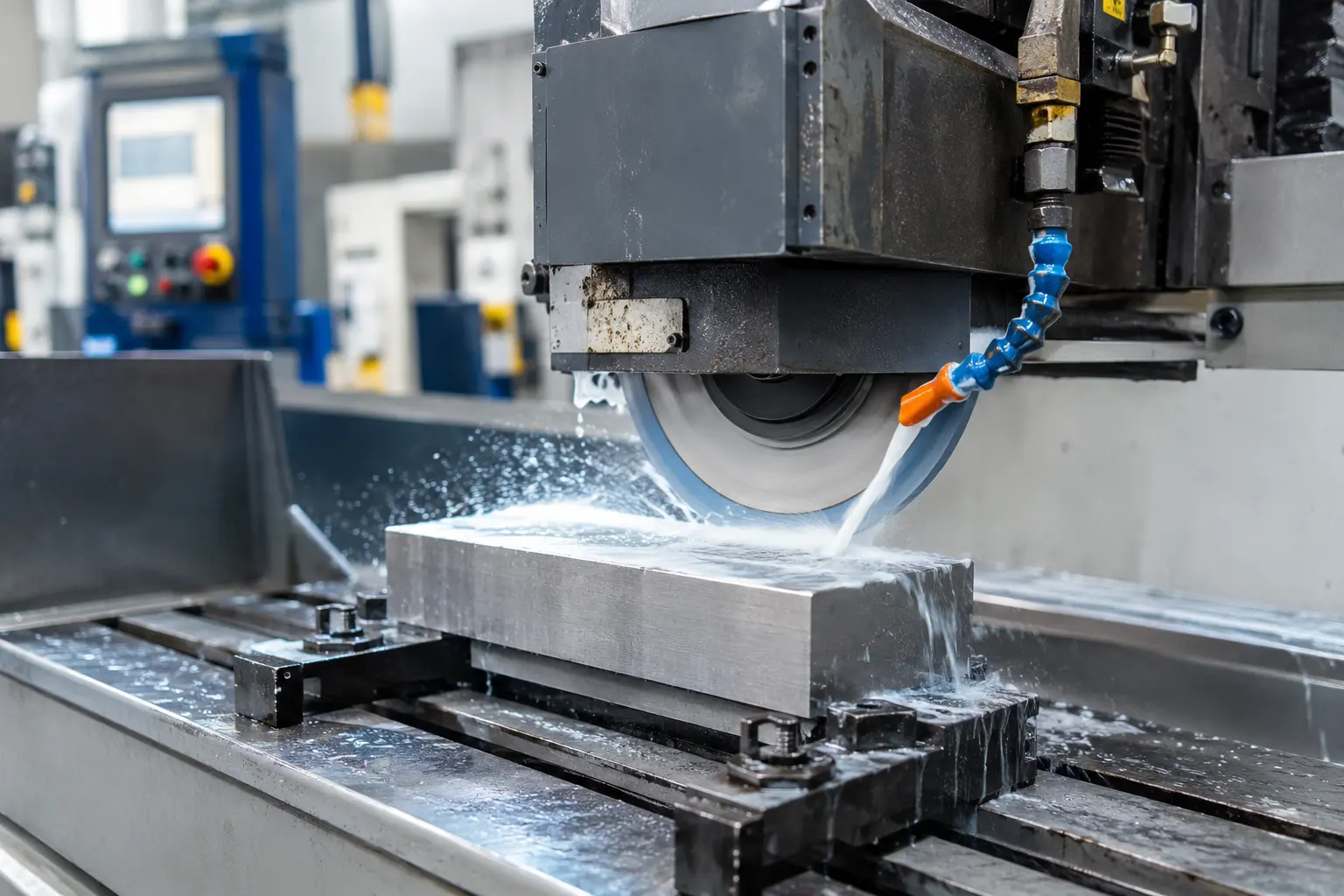
Surface grinding is a machining and finishing operation that uses a rotating abrasive wheel to remove small amounts of material from a workpiece. When performed with the correct machine settings, grinding wheel, and workholding method, it helps manufacturers achieve the required surface finish and dimensional accuracy.
In this guide, we explain what the surface grinding process is, how it works step by step, its benefits, and the factors that influence grinding quality.
What Is the Surface Grinding Process?
The surface grinding process is a precision machining operation used to produce flat, smooth, and dimensionally accurate surfaces on a workpiece. It involves bringing a rotating abrasive grinding wheel into controlled contact with the material while the workpiece moves beneath it. Each abrasive grain on the wheel removes a small amount of material. Multiple controlled passes gradually bring the component closer to its required dimensions and surface finish.
A typical surface grinding machine consists of a grinding wheel, worktable, workholding arrangement, machine controls, and, where required, a coolant system. Depending on the application, manufacturers may use manual, hydraulic, automatic, or CNC-controlled surface grinding machines.
Step-by-Step Surface Grinding Process
Understanding each stage helps manufacturers maintain consistency, reduce defects, and improve production efficiency.
Step 1: Prepare and Inspect the Workpiece
The first step is to inspect the component and identify its material, initial dimensions, required flatness, surface finish, and final tolerances. Remove loose dirt, oil, and other contaminants that could affect workholding or grinding quality. Check the workpiece for machining allowance and determine how much material needs to be removed.
For example, a steel plate that requires a precise thickness must be measured before grinding so the operator can plan the material removal accordingly.
Step 2: Select the Appropriate Grinding Wheel
Grinding wheel selection directly affects cutting performance, surface quality, and productivity.
Consider the following factors:
- Abrasive type: Choose an abrasive suitable for the workpiece material.
- Grain size: Select the appropriate grit for the required material removal and surface finish.
- Wheel grade: Consider how firmly the abrasive grains are held in the wheel.
- Wheel structure: Account for chip clearance, contact conditions, and grinding requirements.
The wheel must also be compatible with the machine and the operating conditions. It should be inspected, mounted, and balanced as required by the manufacturer's instructions.
Step 3: Secure the Workpiece
Correct workholding is essential for dimensional accuracy and operator safety. Depending on the component and its material, the workpiece may be secured using a magnetic chuck, mechanical fixture, or another suitable holding arrangement. Ensure that the contact surfaces are clean and that the component is firmly supported.
Improper clamping or inadequate support can cause movement, vibration, uneven grinding, and dimensional errors. Non-magnetic materials require an appropriate alternative to magnetic workholding.
Step 4: Set Up the Surface Grinding Machine
Before grinding begins, configure the machine according to the component's requirements. Important settings include grinding wheel speed, table movement, feed rate, and depth of cut. These parameters depend on the material, wheel specifications, machine capability, and desired finish.
For repetitive manufacturing, automatic or CNC surface grinding machines can help maintain consistent movement and programmed grinding cycles. At this stage, verify machine condition, guards, coolant availability where applicable, and the correct operation of the controls.
Step 5: Perform the Initial Grinding Passes
Once the setup is complete, begin grinding using controlled cuts. The wheel gradually removes material as the workpiece passes beneath it.
Initial passes generally focus on removing the required machining allowance without applying excessive grinding forces. The operator must monitor the process for unusual vibration, excessive heat, wheel loading, and inconsistent material removal.
For example, when grinding a machine component, controlled passes help bring its surface closer to the required dimensions without unnecessarily removing material.
Step 6: Refine the Surface Finish
After the initial material removal, lighter finishing passes may be used to achieve the specified surface quality and dimensional accuracy. The operator adjusts the grinding parameters as needed and allows sufficient finishing passes for the application. A spark-out pass, during which the wheel continues to traverse the surface without additional infeed, may help reduce residual high spots and improve consistency.
Grinding wheel dressing may also be necessary to restore the wheel's cutting condition and maintain predictable performance.
Step 7: Inspect the Finished Component
The final step is to verify that the component meets the drawing and quality requirements.
Depending on the application, inspection may include:
- Dimensional measurements using suitable instruments.
- Flatness and parallelism checks.
- Surface roughness measurement where specified.
- Visual inspection for burns, scratches, chatter marks, or other defects.
If the component does not meet the specified requirements, the cause should be identified before further corrective grinding is performed.
Factors That Affect Surface Grinding Quality
Several variables influence the results of the surface grinding process:
Grinding wheel condition: A worn, loaded, or improperly dressed wheel can affect cutting performance and surface finish.
Feed rate and depth of cut: Inappropriate settings may cause excessive heat, vibration, or inconsistent material removal.
Workpiece stability: Secure workholding and proper support help prevent movement and distortion.
Coolant application:Where applicable, suitable coolant flow helps manage heat and remove grinding debris.
Machine condition: Alignment, spindle condition, vibration control, and maintenance influence repeatability and accuracy.
Controlling these factors helps manufacturers produce consistent components while reducing rework and unnecessary downtime.
Applications of the Surface Grinding Process
Surface grinding is widely used where components require precise flat surfaces, controlled thickness, or improved surface finish.
Common applications include:
- Automotive manufacturing:Precision-machined components and tooling.
- Tool and die making:Tool and die making: Dies, punches, fixtures, and mould components.
- Bearing manufacturing:Bearing manufacturing: Suitable bearing-related components requiring accurate ground surfaces.
- Industrial machinery:Industrial machinery: Machine parts, plates, and precision mechanical components.
- General engineering:General engineering: Hardened steel components, flat blocks, and tooling elements.
The appropriate machine configuration depends on the component geometry, production volume, material, and required tolerances.
Benefits of the e Grinding Process
When correctly planned and controlled, surface grinding offers several manufacturing advantages:
- Produces smooth, flat surfaces with controlled dimensions.
- Supports close dimensional tolerances when the setup and process are suitable.
- Improves the consistency of precision-machined components.
- Provides an effective finishing operation for hardened materials.
- Supports repeatable production using automatic and CNC-controlled equipment.
These benefits make surface grinding an important process in precision engineering and industrial manufacturing.
How Pinnacle Supports Precision Surface Grinding
Choosing the right surface grinding machine is an important part of achieving consistent production results. Pinnacle Engineering Enterprise manufactures high-precision surface grinding machines, including hydraulic, automatic, rotary-table, and CNC-controlled models for different industrial requirements.
With machine selection based on component size, production needs, and finishing requirements, manufacturers can develop a grinding setup suited to their operations. Explore Pinnacle's surface grinding machines to learn more about available machine configurations. For application-specific requirements, contact the Pinnacle team to discuss a suitable solution.
Conclusion
The surface grinding process is a vital finishing operation for manufacturers that require accurate dimensions, flat surfaces, and consistent component quality. From workpiece preparation and wheel selection to finishing and inspection, every step contributes to the final result.
By understanding these stages and selecting a suitable surface grinding machine, manufacturers can improve process control and meet their component specifications more consistently.
Frequently Asked Questions
1. What is the main purpose of the surface grinding process?
The main purpose is to produce flat, smooth, and dimensionally accurate surfaces by removing small amounts of material with a rotating abrasive wheel.
2. What materials can be surface ground?
Surface grinding is commonly used for steel, hardened steel, cast iron, and other suitable materials. The wheel and process parameters depend on the material.
3. What are the main steps in surface grinding?
The main steps are workpiece inspection, grinding wheel selection, workholding, machine setup, initial grinding, finishing passes, and final inspection.
4. Why is coolant used in surface grinding?
Coolant may help control heat, remove grinding debris, and improve process stability. Its use depends on the material, machine, wheel, and application.
5. How can surface grinding accuracy be improved?
Accuracy can be improved through correct wheel selection, secure workholding, suitable machine settings, proper wheel dressing, controlled grinding passes, and accurate final inspection.
